Setup guides
Pick your device. Each guide is five steps and names the one thing that commonly goes wrong on that platform, which is usually the reason people give up.
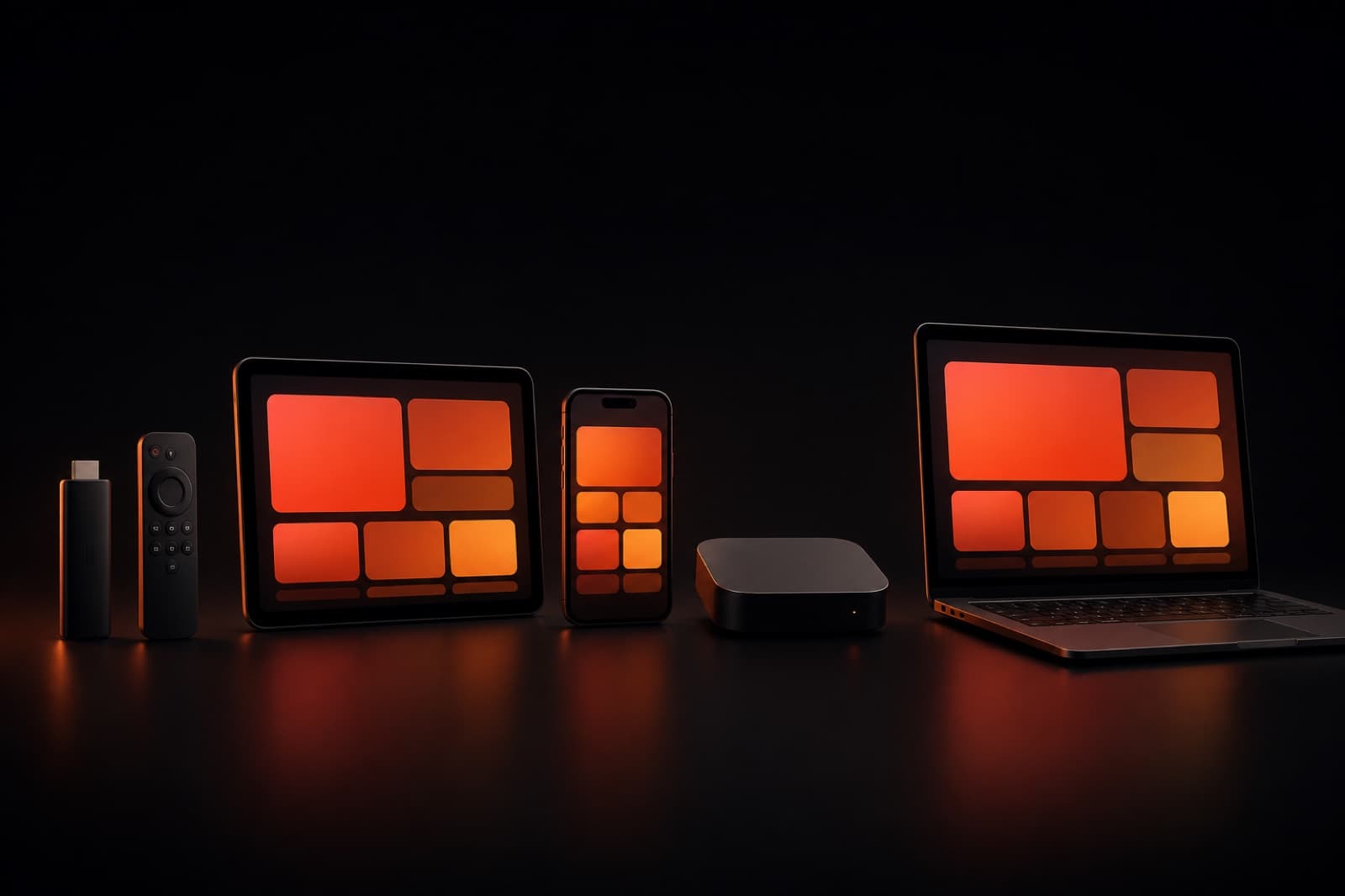
Amazon Firestick
The Firestick is the most common way people watch IPTV, and the only device that needs a setting changed before you start.
About 6 minutesRecommended player: IPTV Smarters Pro
Samsung & LG Smart TV
Tizen and webOS both run IPTV players natively, so there is no extra hardware. The catch is that these apps identify your TV by MAC address.
About 8 minutesRecommended player: Smart IPTV / IBO Player
Android TV & Google TV
Android TV gives you the best player in the category. TiviMate is worth the paid tier if you watch live sport.
About 5 minutesRecommended player: TiviMate
iPhone, iPad & Apple TV
Apple's App Store review means every iOS player is legitimate, which makes this the safest device to set up and the fastest.
About 4 minutesRecommended player: GSE Smart IPTV
Windows & Mac
The quickest way to check whether a stream is working. If it plays in VLC on a laptop, the problem on your TV is the TV.
About 3 minutesRecommended player: VLC / Perfect Player
MAG & Formuler boxes
Dedicated set-top boxes use a portal instead of an app. Slightly more work up front, and then nothing ever changes.
About 7 minutesRecommended player: Stalker Portal
What you receive at activation
Credentials arrive by email about 5 minutes after payment — check your spam folder if they are not there. You get whichever of these formats your player needs: MAG portal, M3U, EPG URL, Username and password, Xtream Codes.
Any of them will run on 10 Mbps or more per screen.
Every guide below follows the same four steps, because every platform works the same way underneath: install a player, enter your credentials, wait for the list to load, then fix the two or three things that are wrong. What differs between devices is only where the settings hide.
What you need before you start
- Your credentials, whichever format they arrived in. Most players accept either a portal address with a username and password, or a single subscription URL.
- The device you will actually watch on, not the one that is easiest to reach.
- An Ethernet cable if the television is anywhere near the router. This is the single biggest improvement available and it costs a few pounds.
- Twenty minutes, and not twenty minutes before something you want to watch.
The three things that go wrong first
Across every platform, the same small set of problems accounts for most first-day failures.
| Symptom | Usual cause | Fix |
|---|---|---|
| Nothing loads at all | A typo in the portal address or credentials | Retype rather than paste; check for a trailing space |
| List loads, nothing plays | Player cannot reach the stream, or the connection limit is already used | Close other devices, then retry one channel |
| Guide times are an hour out | Device clock or time zone set manually | Set the device to automatic time |
| Plays, then stalls repeatedly | Wireless congestion or evening load | Wire the device, then retest at the same hour |
| Some channels fine, others dead | Individual feeds have failed upstream | Use a second feed of the same channel |
If the picture is stalling rather than failing to start, the buffering diagnostic is the faster read. It separates causes into the device, the local network and the feed itself, and works through them in the order that resolves most cases quickest.
Which device to choose if you have not bought one
A streaming stick is the usual answer and the cheapest. It sidesteps the main weakness of built-in television software, which is that manufacturers stop updating apps years before the set stops working. A stick is also replaceable for the price of a takeaway if it fails, whereas a television is not.
Built-in smart TV apps are fine when the set is recent and the app store carries a current player. Older sets are where most compatibility complaints originate, and no provider can fix a television that stopped receiving app updates in 2019. Dedicated set-top boxes remain the most capable option and the least friendly to anyone who did not choose them.
Whichever you pick, favourites are what make a large catalogue usable. Build the list once during setup and you will use perhaps thirty entries thereafter, which is the catalogue as you will actually experience it rather than as a total.